
A high-risk drug is one where the gap between therapeutic dose and harm is narrow, monitoring requirements are strict, and the consequences of a missed check can land a patient in hospital. Lithium. Methotrexate. DOACs. Amiodarone. The list is well known. The systems for monitoring them in primary care are not.
Most practices have a process. Fewer have a process that survives the second pharmacist leaving and the third GP joining. This piece sets out what working high-risk drug monitoring looks like in 2026.
What counts as high-risk in primary care
NHS England guidance (covering the medicines-safety remit formerly held by NPSA) defines the headline list. In practice, the drugs that account for most monitoring failures are:
- DOACs (apixaban, rivaroxaban, edoxaban, dabigatran)
- Lithium
- Methotrexate
- Amiodarone
- DMARDs (azathioprine, leflunomide, hydroxychloroquine)
- Warfarin
- Antipsychotics in dementia patients
- Long-term NSAIDs in patients over 65 or with CKD
Each has different monitoring frequency requirements. None can be safely managed without a registered, dated bloods schedule. Most can be audited from EMIS, SystmOne, Vision or Medicus in under 20 minutes.
Where monitoring fails
Three patterns recur.
Patients lost between systems. A patient starts methotrexate under rheumatology. Rheumatology assumes the GP will monitor. The GP assumes rheumatology is. The patient gets six months of methotrexate with no FBC.
Bloods done, results unreviewed. The phlebotomist takes the sample. The result lands in the GP’s inbox. Nobody is named as the person responsible for reviewing it against the monitoring criteria. The result sits unread.
Monitoring drift. The patient started at three-monthly. Bloods got six-monthly during a busy quarter. Six-monthly turned into nine-monthly. A year later, monitoring has fallen well below the prescribed cadence and nobody noticed.
Each pattern is a process failure. None of them are individual clinician failures.
Who is actually responsible
In most practices, three roles touch high-risk drug monitoring. The GP who prescribes (or holds prescribing responsibility from secondary care), the clinical pharmacist who runs the monitoring system, and the pharmacy technician who supports the admin work.
The clinical pharmacist is the role that holds the system together. The GP signs prescriptions. The pharmacist runs the patient list, the bloods schedule, the result review, and the GP escalation. The technician handles patient contact, blood form generation, and lab follow-up.
Practices without a pharmacist usually rely on EMIS, SystmOne, Vision or Medicus searches managed by a partner GP. Workable, but the partner ends up doing pharmacist-level work at GP cost.
What a working monitoring system looks like
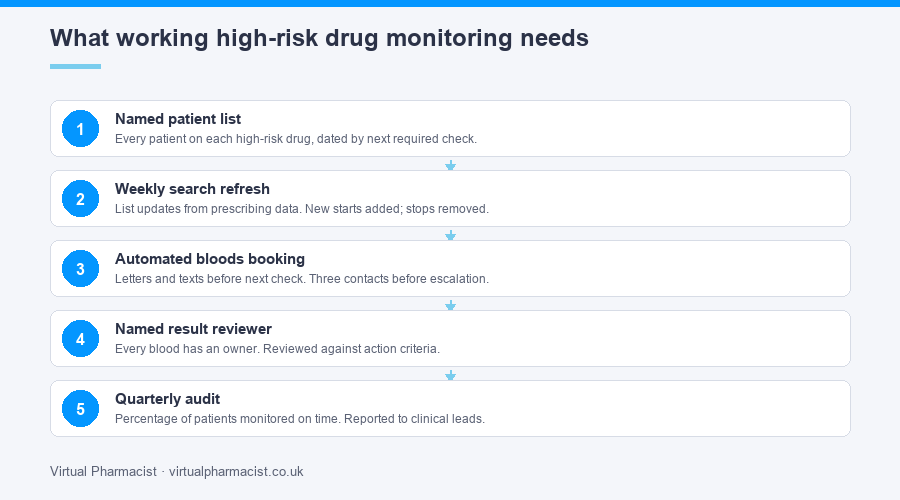
Five elements in combination.
A named patient list. Every patient on each high-risk drug, dated by the time of the next required check.
Searches refreshed weekly. The patient list updates itself from prescribing data. New starts appear automatically. Stops drop off after a verified discontinuation.
Bloods booking that does not depend on the patient. Letters and texts go out automatically when the next check date approaches. Three contacts before escalation. Phlebotomy appointments booked in batches once a fortnight.
Result review by named clinician. Every blood result has a named reviewer. The reviewer signs the result against agreed action criteria. Out-of-range results trigger immediate clinician contact, not a queue.
Quarterly audit. The pharmacist runs a quarterly audit of monitoring adherence. Percentage of patients with bloods within agreed intervals. Audit results go to clinical leads.
A practice that has all five does not have monitoring failures. A practice missing two or more usually does.
Running a high-risk drug audit
The audit itself is straightforward and worth running annually even where the system looks healthy.
Pull the list of patients on each high-risk drug. Cross-reference with the most recent monitoring blood. Calculate the percentage with bloods inside the prescribed monitoring window. Investigate the ones outside. Document the corrective action.
Across the practices we support, a first audit typically finds 15% to 25% of patients on high-risk drugs with overdue monitoring, and a year of corrective action usually brings that below 5%. Those are our own observed figures rather than a published benchmark.
When to call in support
If your practice has had two or more incident reports related to high-risk drug monitoring in the past 12 months, the system is the issue, not the people. The same applies if a CQC inspection has flagged monitoring as a concern.
We deliver high-risk drug monitoring as a managed clinical service, with our clinical pharmacist team operating under Virtual Pharmacist’s clinical governance. Our clinical pharmacist support service covers the full setup. Get in touch if you want a quick external review.
Frequently asked questions
What does a working high-risk drug monitoring system need?
Five elements in combination: a named patient list dated to the next required check, searches refreshed weekly from prescribing data, bloods booking driven by the practice rather than the patient, a named clinician reviewing every result against agreed action criteria, and a quarterly audit of monitoring adherence.
How many patients are usually overdue monitoring?
Across the practices we support, a first audit finds 15% to 25% of patients on high-risk drugs outside the prescribed monitoring window, and a year of corrective action normally brings that below 5%. Those are our own observed figures rather than a published benchmark.
Who holds responsibility for high-risk drug monitoring?
The clinical pharmacist holds the system together, running the patient list, the bloods schedule, result review and GP escalation. The GP retains prescribing responsibility, and a pharmacy technician supports patient contact, blood form generation and lab follow-up.
When is it worth bringing in outside support?
Two or more incident reports related to high-risk drug monitoring in 12 months points at the system rather than the people, as does a CQC inspection flagging monitoring as a concern. Our high-risk drug monitoring service covers the full setup.