

Structured Medication Reviews are not new. NHS England has commissioned them since 2020, and PCNs carry a target number to deliver each year under the Network DES. What has shifted in 2026 is the expectation that the reviews are evidenced, audited, and acted upon. Not just counted.
This guide covers what an SMR is, who qualifies, the seven-step framework most PCNs use, what good documentation looks like, and the operational mistakes that turn an SMR programme into a tick-box exercise.
What an SMR is, and what it is not
An SMR is a planned consultation where a clinician reviews every medicine a patient is taking, the reason each was started, whether it is still doing the job it was prescribed for, and what could be stopped, swapped, or dose-adjusted. It is documented. It changes prescribing. It is followed up.
It is not an annual repeat prescription review. It is not a chronic disease review where medication happens to come up. The clinical scope is wider, the documentation richer, and the time slot longer. Usually 30 to 45 minutes for a first SMR. 20 to 30 minutes for a follow-up.
Who qualifies for an SMR
NHS England priority cohorts are stable from year to year. PCNs should focus on:
- Care home residents
- Patients on 10 or more regular medicines
- People with frailty (Rockwood 6 or above)
- Patients on high-risk drugs (DOACs, NSAIDs in older adults, lithium, methotrexate, antipsychotics in dementia)
- Patients identified through searches for problematic prescribing combinations
In practice, most PCNs draw their first SMR cohort from care home residents. The patients are easy to identify, the polypharmacy is dense, and the clinical return on each review is high.
The seven-step approach
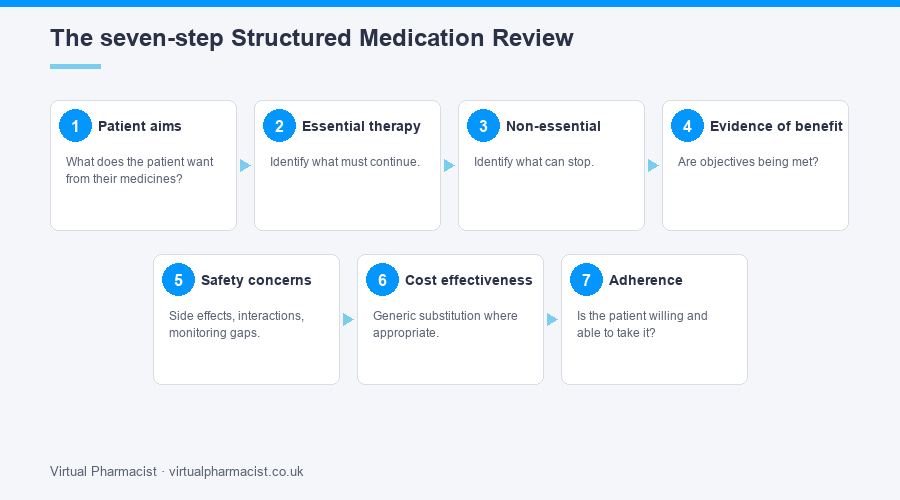
Most NHS regions teach a variant of the seven-step SMR model. The steps run roughly:
- Identify the aim of the review with the patient. What do they want from their medicines?
- Identify essential drug therapy. What must continue?
- Identify non-essential or no-longer-effective therapy. What can stop?
- Are objectives being met by the current drugs? What is the evidence of benefit?
- Are there safety concerns. Adverse effects. Interactions. Monitoring gaps.
- Is the medication regimen cost-effective. Generic substitution. Brand to generic.
- Is the patient willing and able to take the medicines as prescribed.
The order is less important than completing each step. SMRs that skip step 1, the patient conversation, read like internal audits rather than reviews.
What good documentation looks like
A well-documented SMR has three things a thin one does not. First, the patient’s view of their medicines in their own words. Second, an explicit decision against each drug. Continue, stop, dose change, swap, consultant review, or patient declines. Third, a follow-up action with an owner and a date.
PCNs that audit their SMR documentation usually find the first item missing on the majority of reviews. The patient voice is the part that distinguishes an SMR from a prescribing review.
Where SMR programmes fail
Four failure modes account for most of the problems.
Reviews counted on the wrong code. The Network DES reimburses against specific SNOMED CT codes. Reviews coded under generic medication review SNOMEDs do not count, even when the underlying clinical work is identical. Annual audit catches this. Annual audit is too late.
No follow-up. A review without a follow-up is a recommendation in a vacuum. The pharmacist proposes stopping a statin. The GP never actions the change. The patient is back on it at the next prescription cycle.
One-shot model. Treating SMRs as one-off events instead of an ongoing programme means the next year’s reviews start from the same cohort baseline as the previous year.
Pharmacist isolation. A pharmacist doing 30 SMRs a week with no peer discussion drifts into routines that nobody else challenges. Monthly cohort discussion is what keeps SMR quality honest.
What an effective SMR cadence looks like
The PCNs that deliver SMR targets sustainably tend to share a few features.
Reviews are pre-booked. A pharmacist’s diary three weeks ahead has named SMR slots, with the patient cohort already identified through EMIS, SystmOne, Vision or Medicus searches. Same-day SMRs squeezed between other appointments rarely meet the documentation bar.
Searches are run centrally. One person at PCN level extracts the eligible cohort each month and distributes it across practices. Practices that build their own searches end up with patchy criteria.
Documentation templates are shared. A single SMR consultation template, written once and refined together, removes variation between pharmacists and makes audit straightforward.
Outcomes are reported. Each quarter, the PCN reports number of SMRs completed, number of medicines stopped, number of medicines started, average prescribing cost change per patient, and number of patients escalated to GP or consultant review.
Where to get help
If your PCN is missing its SMR target, or finishing reviews that audit poorly, the usual remedy is not more pharmacist hours. It is structure. Cohort definition. Consultation templates. Supervision. Reporting.
We deliver SMR programmes end to end for PCNs. Pharmacist-led reviews, searches, templates, documentation, and quarterly reporting under one managed service. Our medication review service covers the operational lift, or get in touch for a scoping conversation.
Frequently asked questions
What separates an SMR from an annual medication review?
An SMR is wider in clinical scope, richer in documentation and longer in the slot. It covers every medicine the patient takes, the reason each was started, whether it is still doing that job, and what could stop, swap or change dose. First reviews usually run 30 to 45 minutes.
Who should be in the first SMR cohort?
Care home residents are where most PCNs start. The patients are straightforward to identify, the polypharmacy is dense, and the clinical return on each review is high. NHS England's other priority groups are patients on 10 or more regular medicines, frailty at Rockwood 6 or above, and patients on high-risk drugs.
Why do SMR programmes miss their target?
Four failure modes account for most of it: reviews coded against generic medication review SNOMEDs instead of the specific ones the Network DES reimburses, recommendations left with no follow-up, treating SMRs as one-off events when they work as an ongoing programme, and pharmacists working without monthly peer discussion.
What does a sustainable SMR cadence look like?
Reviews pre-booked three weeks ahead against a cohort already identified through EMIS, SystmOne, Vision or Medicus searches, one central PCN-level search feeding every practice, one shared consultation template, and quarterly reporting of reviews completed and medicines changed. Our medication review service covers the operational lift.