
Tools and calculators
Tools for primary care teams
Free tools for primary care pharmacy teams: simulation training you can try without an account, and a calculator for working out what your ARRS allocation covers.
Every tool here shows its workings. Each one sets out how the figure is reached, what it does not cover, and the sources behind it, so you can judge the answer rather than take it on trust.
Medicine in Practice
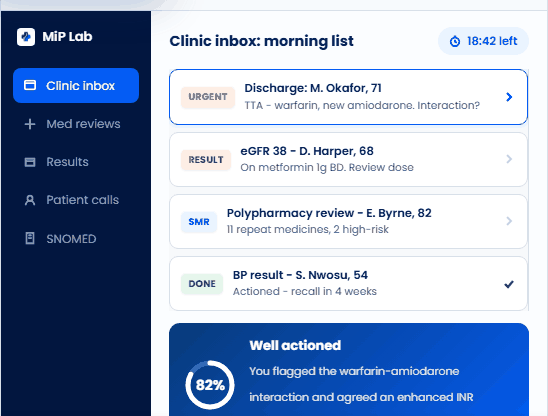
Our training platform. Pharmacy students, pharmacists and technicians practise realistic UK primary care work with fictional patients, and get structured feedback on every decision.
The labs mirror a working clinic day: a clinic inbox, medication reviews, results, patient calls and SNOMED coding. Work is scored against nine core competencies, with a route from foundation through to advanced practice.
There is a free demo lab that needs no account and no card. Practices, PCNs, systems and universities can set up access for a whole team.
What the simulator covers
Six areas, each drilled against the work that actually lands in a primary care inbox.
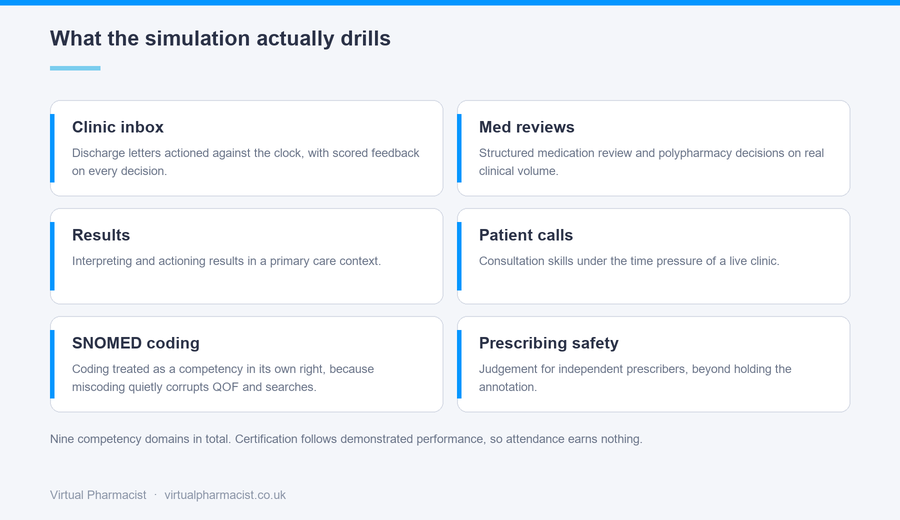
Competence is evidenced against a nine domain framework, and a certificate carrying a verification ID is issued to the pharmacist. Virtual Pharmacist recognises that certificate as an assurance benchmark for our own clinical team.
That is how we evidence clinical competence rather than asserting it, set out in full in how clinical competence is evidenced.
ARRS allocation calculator
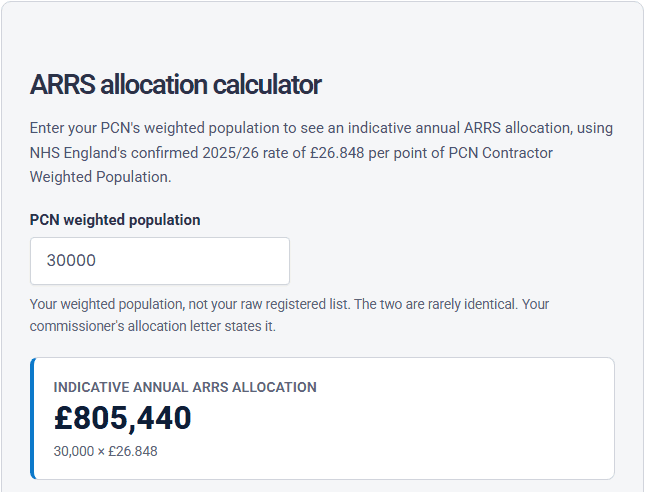
Enter your weighted population and see an indicative annual ARRS allocation, calculated from the published national rate.
The page states the rate it uses and where that rate comes from, explains why weighted population is not the same as your registered list, and says plainly what the calculator does not tell you. It cites its sources.
Guides that do the job of a tool
Some questions are answered better by a worked method than a calculator.
How ARRS funding works
How the allocation is calculated, what it pays for, and how the money reaches a network.
Outsourced or in-house
The trade-off set out honestly, including where building your own post is the better route.
Choosing a provider
Six things to score for every provider on your shortlist, and what a strong answer looks like.
The 2026/27 contract
What changed this year and what it means for the medicines workload landing on your desk.
MedReview for NHS teams
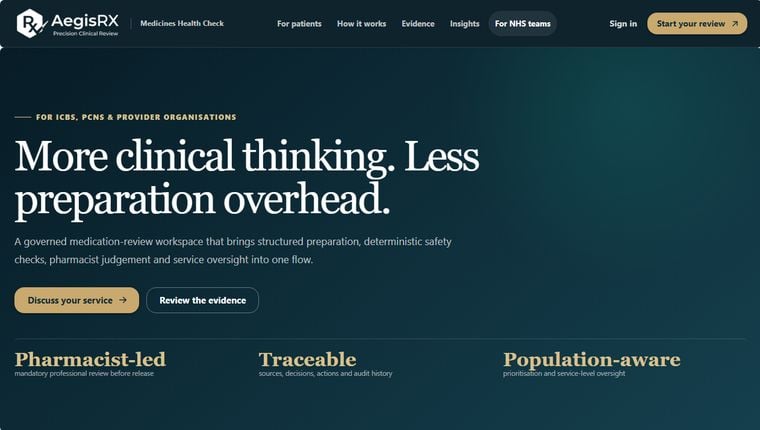
A governed medication-review workspace for ICBs, PCNs and provider organisations, bringing structured preparation, safety checks, pharmacist judgement and service oversight into one flow.
Three things define how it works. Every review is pharmacist-led, with mandatory professional review before anything is released. Everything is traceable: sources, decisions, actions and audit history. And it is population-aware, so prioritisation and service-level oversight sit alongside the individual review.
It releases clinical capacity by taking the preparation overhead off the pharmacist, while keeping the clinical decision, and the accountability for it, exactly where it belongs.
Want the numbers for your own network?
A calculator gets you an order of magnitude. For a figure built around your actual list size, practice count and workload, we can work it through with you. No obligation attached.