

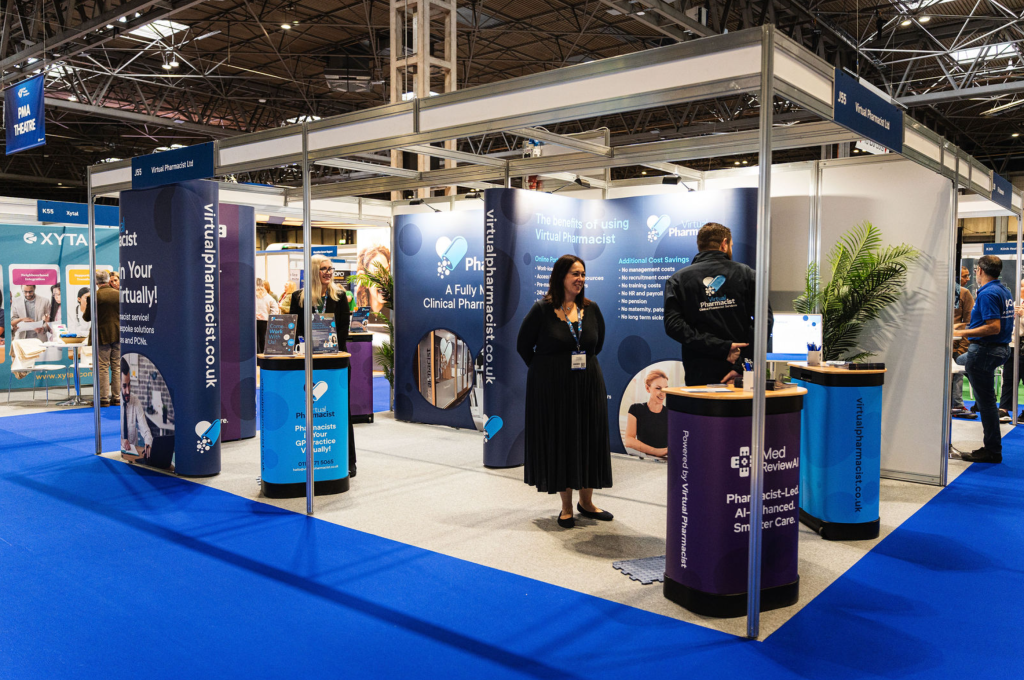
Seven case studies in managed clinical pharmacy, from UK GP practices and PCNs. Names withheld as standard. Every practice and PCN below is a customer we invoiced and delivered for. Where a story names a county or an ICB, that is as specific as we go without the customer’s written consent.
Figures are Virtual Pharmacist’s own service data as at August 2026.
- 375+ GP practices
- 88+ PCNs
- Practices and PCNs supported across 23 ICB areas
- 7 of 7 NHS regions
- 100+ pharmacists and pharmacy technicians under one clinical governance framework
- 85% of our pharmacists are independent prescribers
- Since 2021
Why none of these name the practice
These examples are anonymised to respect our clients’ preferences. We name a practice or PCN only with its permission.
With the client’s permission, we can arrange a reference call with a practice or PCN using a relevant service.
It does leave you taking our word for the details, so here is what we offer instead.
What you can check for yourself
- A reference call. Ask, and we will put you on a call with a practice or PCN doing the work you are considering. They can say whatever they like to you. That is the point.
- The public record. Where a story rests on something published by someone other than us, an ICB tariff, a QOF indicator, a CQC report, we say so and you can go and read it.
- The method, in full. The search schedule below is the real one, published in full. Compare it with anything else you have been shown.
- Our own service figures. 37 of 65. 315 hours. £2,960. Exact counts are shown where available; estimates are labelled separately.
- Scoped, delivered, invoiced. Every case study here was scoped as a defined piece of work, delivered under our own protocols and clinical supervision, and invoiced against what was delivered.
Medicines safety · Northamptonshire · three GP practices
Medicines-safety support before three inspections.
Three practices called us late, separately, each with an inspection date already set and a medicines-safety position it could not evidence. Monitoring the team believed was in hand but could not show. High-risk medicines with no recent record of review. Safety alerts that had been read but never worked through patient by patient.
Module C, at pace. The full search set was built and run across each practice’s whole registered list, then worked the only way that counts: every flagged patient reviewed individually by a pharmacist, every action taken and coded contemporaneously in the practice’s own clinical system.
At each practice the full set was built, run and worked through inside two weeks. The fastest cleared in a single week. All three practices received medicines-safety support ahead of their inspections. One of the three went on to commission a rolling medicines-safety programme, over 400 hours of delivered work, and a multi-year technician service.
“We are so grateful to you and your team for getting us to this point, and it is a huge relief. CQC commented on the high quality medication reviews that have been undertaken by your team.”
Practice leadership, on publication of the practice’s CQC report
What this is, and what it isn’t. We don’t sell mock inspections, evidence packs or consultancy reports. None of those change what is on the patient record, which is what gets looked at. What Module C delivers is the substance underneath: the clinical work itself, plus a concise patient-safety summary of the searches run, patients reviewed, actions completed and matters referred. It evidences the care you commissioned, and it may support your practice’s own CQC evidence. This work is available to practices across Northamptonshire and nationally.
Scale · Norfolk & Waveney · PCN
A thousand structured medication reviews in one winter
A PCN needed a defined block of structured medication reviews delivered inside a single winter. There was no capacity to recruit for it, and no appetite for an open-ended arrangement that would still be running in the summer.
1,000 SMRs, delivered as a counted block on a fixed fee between October 2025 and March 2026. Alongside it we ran an AI-supported review workstream and a continuous technician service, all under the same governance and all inside the PCN’s own clinical systems.
Delivered on time and in full. Volume without losing the individual assessment: every review a real clinical encounter with a documented clinical conclusion, coded on the record as it was done.
Local incentive scheme · Derbyshire, then a second ICB area · GP practice
A medicines project supporting an eligible incentive claim
An ICB enhanced service was paying practices a published £80 item-of-service for each anticoagulant switch. The money was on the table. The clinical time to earn it was not, which is why schemes like this so often go unclaimed.
We screened the anticoagulant register, then reviewed every screened patient individually and made the switches that were clinically right for that patient. Where a switch was not right, no switch was made, whatever the tariff pays.
At one practice, 37 of the 65 patients screened were switched. £80 a patient does not sound like much until you multiply it: the practice claimed £2,960. This is the gross incentive claimed, before service fees and other costs; it is not a measure of net financial benefit. We then ran the same model in a second ICB area.
Schemes like this run in most areas. Finding the one live in yours is part of the job.
Scale · Lincolnshire · nine-practice PCN
Nine practices. One PCN. One clinical standard.
Nine practices, nine different positions on medication reviews, and nine separate recruitment problems if the PCN tried to fix it by hiring.
A defined block of medication reviews, 315 hours of it, scoped across the network and delivered remotely inside each practice’s own clinical system, to one pathway and one clinical standard.
The block ran, then the PCN moved to a full-year contract covering the whole network. Every practice on the same footing, with nothing to recruit and no rota to manage.
Network-level medicines work like this is available across Lincolnshire and every other ICB in England.
Quality funding · c.6,000-patient GP practice
A whole QOF register, handed over in August instead of March
Medicines-related QOF work at a c.6,000-patient practice, spread across many registers, all of it landing on the same clinical team and all of it converging on the same March deadline.
We mapped the registers against the indicators, agreed the cohort with the practice, and worked it across the year instead of at the end of it. One governed pathway supported around 26 medicines-related QOF indicators, as defined in NHS England’s published QOF guidance.
Registers worked end to end, with every patient individually assessed and the clinical work coded in the practice’s own system as it went. Submission, personalised care adjustments and dashboard management stayed with the practice, as they always do. We deliver the clinical work behind the indicators. The return stays with your team.
Planning medicines-related QOF work earlier in the year gives practices more time for reviews, follow-up and coding checks.
Combined recall lists · Cheshire, the Bristol area and nationwide
Review the patient, not the list
Most patients on a recall list sit on more than one of them: the diabetes register, the asthma register, the polypharmacy list, a QOF recall now due. Worked list by list, that is four invitations, four appointments and four chances to DNA.
We coordinate overlapping recall lists so patients can discuss relevant medicines and conditions together where appropriate. Actions and follow-up are recorded. Some patients need staged reviews, further information, referral or another appointment.
The same governed pathway carried heart-failure reviews in Cheshire, diabetes work in the Bristol area, and a three-year look-back over MHRA safety alerts, re-run patient by patient.
Retention · nationwide
Bought once, then bought again
Our longest-standing practices and PCNs have been with us since 2021: five years of continuous service, renewed year after year. The pattern repeats at every size. One Derbyshire practice commissioned three separate blocks of work in twelve months. A Somerset PCN followed a 287-hour block of medication reviews with an extension. A Kent PCN renewed for 2026/27. A Northamptonshire practice turned a defined 500-review project into a rolling programme and a multi-year technician contract.
Defined work, delivered, then bought again. That is the real audit. And practices are now moving onto longer, multi-year contracts, securing the service for their teams on the strength of what has already been delivered.
“I would fully recommend VP as a remote pharmacist solution.”
PCN Manager, c.90,000 population, with us since 2021
The search schedule, published in full
The Northamptonshire case study above rests on this. It is the named schedule of clinical-risk searches that runs across a practice’s whole registered list under Module C, and it is the same seven streams at every practice. Nothing about it is proprietary, so you can hold it up against anything else you have been shown.
In their words
From senior partners, practice managers and PCN leads, and from patients.
“Since Virtual Pharmacist took on our prescription signing, I get a lunch break… What more do I need to say!”
PD · Senior Partner, GP practice“It has dramatically reduced the GPs’ workload, they are happy and that makes me happy!”
JH · Practice Manager“Thank you all for your fantastic work on the CHOL003 indicator so far. You’ve made amazing progress, and we are very grateful.”
J.A. · GP practice, Suffolk · QOF cholesterol programme“Takes pressure off GPs, adding quality in medicines management.”
RP · Clinical Director, PCN“We’ve received some positive feedback from one of our GPs regarding the acute requests. They feel it’s working well, are very grateful for the help and have already noticed a difference.”
H.A. · GP surgery, Hampshire“Appointment was on time and the pharmacist was easy to talk to. Very helpful, polite and informative.”
Patient · telephone appointment, DevonTwenty minutes, and we’ll tell you which of these applies to you
Send us your list size and the pressure point, and we’ll come back with a fixed-fee scope. If there’s a local scheme that would pay for the work, we’ll tell you what it is and what it’s worth before you commit anything.
And if you want to hear it from a practice rather than from us, ask for a reference call. We’ll arrange one with a client doing the work you’re considering.
Figures are internal Virtual Pharmacist data as at August 2026 and are updated periodically. Testimonials are from Virtual Pharmacist service feedback records, lightly edited for length; attributions anonymised. Winner: Pharmacy Solutions Provider, General Practice Awards.
QOF and local incentive income depends on current rules, patient eligibility, coding and wider practice achievement. QOF, local incentive and commissioner returns, personalised care adjustments and dashboard management always stay with your team. Funding eligibility varies by area and year and must be confirmed locally.
Virtual Pharmacist’s services are provided as managed clinical services under Virtual Pharmacist’s protocols; they are not a supply of staff. The patient-safety summary provided under Module C evidences the clinical service delivered; it is not a CQC consultancy, inspection-readiness product or regulatory assurance opinion. Read our clinical governance and data security framework.
Virtual Pharmacist Ltd. Registered in England and Wales, company no. 13258094. Registered office: Queen Street Chambers, 68 Queen Street, Sheffield S1 1WR.