

The Clinical Director role is one of the strangest jobs in the NHS. Part GP partner. Part service manager. Part workforce lead. Part politician. No clinical training prepares anyone for the political workload. Most CDs do the job for a year or two and step down with a clear view of what would have helped.
This piece sets out the pressures that consume the time, the structural fixes that work, and where outside support changes the day-to-day.
The role on paper
The Network DES specifies the CD as the named clinical leader of the PCN. For 2026/27, core PCN funding combines the previous core funding, Clinical Director payment and PCN leadership and management payment. The agreed time commitment should reflect the PCN’s local arrangements and actual workload. The role covers clinical service delivery across the network, workforce decisions for ARRS roles, peer relationships between member practices, and the PCN’s interface with the ICB.
That is the description. The actual job is wider.
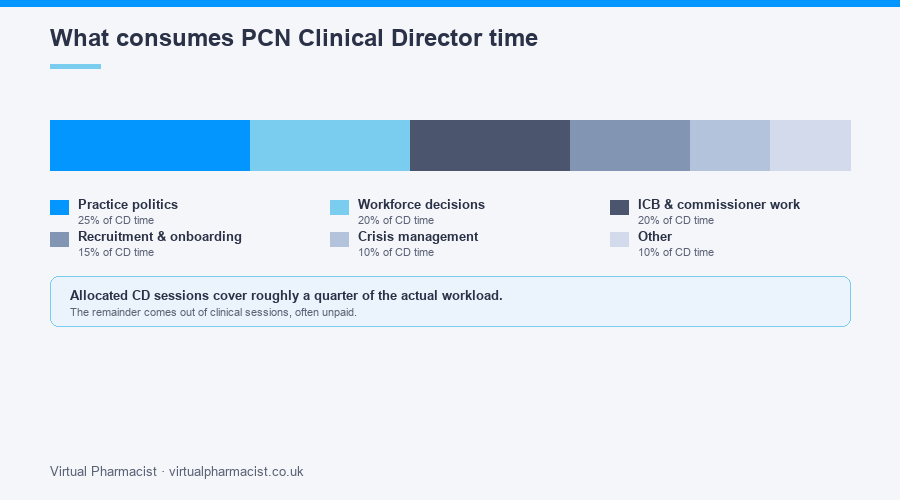
The pressures that actually consume the time
Practice politics. Six practices in a PCN means six sets of partners, six clinical lead voices, six histories with each other. Disputes over patient allocation, ARRS pharmacist sharing, premises decisions, premises money, capitation differences. The CD chairs the room. The CD also delivers the bad news afterwards.
Workforce decisions. Which ARRS roles to recruit. Which practices get the first pharmacist. How supervision is shared. What happens when a role leaves mid-year and the reimbursement schedule shifts. The decision sits with the CD.
ICB and commissioner-facing work. Funding bids. Service redesign meetings. Quality assurance returns. Innovation funding applications. CQC alignment with PCN-level services. None of this is in the job description in detail. All of it lands on the CD.
Recruitment and onboarding. New ARRS roles. Replacing departing staff. Sign-off on contracts. Initial induction. The CD’s name is on the paperwork.
Crisis management. A safeguarding concern raised against a PCN staff member. A patient complaint that crosses practices. A whistleblowing event. Each one is a multi-day distraction.
The demands of the role can exceed the time allocated. PCNs should review actual workload and agree protected time, responsibilities and support.
Where the role breaks
Three patterns recur.
CD burnout. Sustained work beyond agreed sessions can make the role difficult to sustain alongside clinical practice. Regular workload reviews and protected support time can help identify pressure early.
Partner relationship damage. A CD who has had to deliver enough hard decisions across six partnerships ends up with strained relationships in their own practice. The home practice no longer wants them taking the role.
Drift. The PCN does what it has always done because the CD does not have the bandwidth to drive change. The annual PCN plan repeats the previous year’s, with the same gaps.
What good CD support looks like
Three forms of support can help Clinical Directors manage the role.
A PCN manager. Not a partial-FTE add-on. A named, paid-for PCN manager who handles the operational lift. The CD chairs strategic discussions. The manager runs the day-to-day.
Defined supervision for ARRS staff. A senior clinician separate from the CD who holds the supervision responsibility for the pharmacist, technician, social prescriber, and care coordinator cohort. The CD oversees. The senior clinician supervises.
Outsourced specialist work. ARRS pharmacist deployment, innovation funding bids, service evaluation. Areas where the work is specialist enough that internal capacity is rarely the right choice.
What to outsource
Three areas account for most of the gains.
ARRS-funded pharmacy work. Recruiting, supervising and governing a pharmacy team is significant legwork. A managed service delivers the clinical work itself, holds the supervision and governance, and leaves the CD with the strategic call.
Innovation funding. Bid writing and project delivery are specialist skills. The CD’s time is more valuable on patient and partner-facing work than on grant applications.
Service evaluation. Specialist data work that shows what the network’s services deliver. Decide whether to deliver it internally or commission support by assessing skills, capacity, governance and cost.
Where we help
We work with PCNs to take the operational layer off the Clinical Director. ARRS-funded clinical pharmacy work, delivered with supervision, governance and reporting under one managed service. Innovation funding and service evaluation as separate workstreams.
Our PCN management support service covers the CD support side. Get in touch for a conversation.
Frequently asked questions
How much time does the Clinical Director role actually take?
The time needed varies with the network's size, responsibilities and support. Check current DES funding arrangements and agree protected sessions against the actual workload, with regular review.
What separates a Clinical Director who lasts from one who steps down?
Three structures recur. A named, paid PCN manager who runs the operational day to day. A senior clinician other than the CD holding supervision for the ARRS cohort. Specialist work such as funding bids and service evaluation placed outside the network.
Which parts of the PCN workload are best commissioned externally?
ARRS-funded clinical pharmacy work, innovation funding bids, and service evaluation. Each is specialist enough that building the capacity inside the network rarely pays back, and each carries a heavy operational load that lands on the CD by default. Our PCN management support covers this.